
British Columbia's Pay Transparency Act now requires most employers to include wage or salary information in publicly advertised job postings. The law went into force on November 1, 2023. Other provinces are moving in the same direction. (BC Pay Transparency Act, bclaws.gov.bc.ca; guidance on job postings, gov.bc.ca.)
Most employers treat this as a compliance task. They assign a range to each posting, check the box, and move on. That misses the larger opportunity. Salary bands are not just a way to satisfy the law. They are a management tool. They give employees a roadmap and force the organization to explain how people move through pay.
Compliance is the floor, not the point
The legal requirement is simple: the posting must include the expected pay. In BC, that can be a range, a rate, or a fixed amount. The government guidance makes clear that the range should reflect what the employer reasonably expects to pay for the role. (BC guidance on wage or salary information on job postings.)
But compliance does not require the employer to explain how the range was built, how an employee moves from the bottom to the top, or what happens when someone exceeds the top. That is where the real value lives. A posting range without an internal salary structure is like publishing a map without roads.
What salary bands actually are
A salary band is the minimum and maximum pay for a defined job level. The band is tied to the role, not the person. Two employees in the same band can be at different points in it based on experience, performance, tenure, or market factors. The band gives both the employee and the manager a shared frame for those conversations.
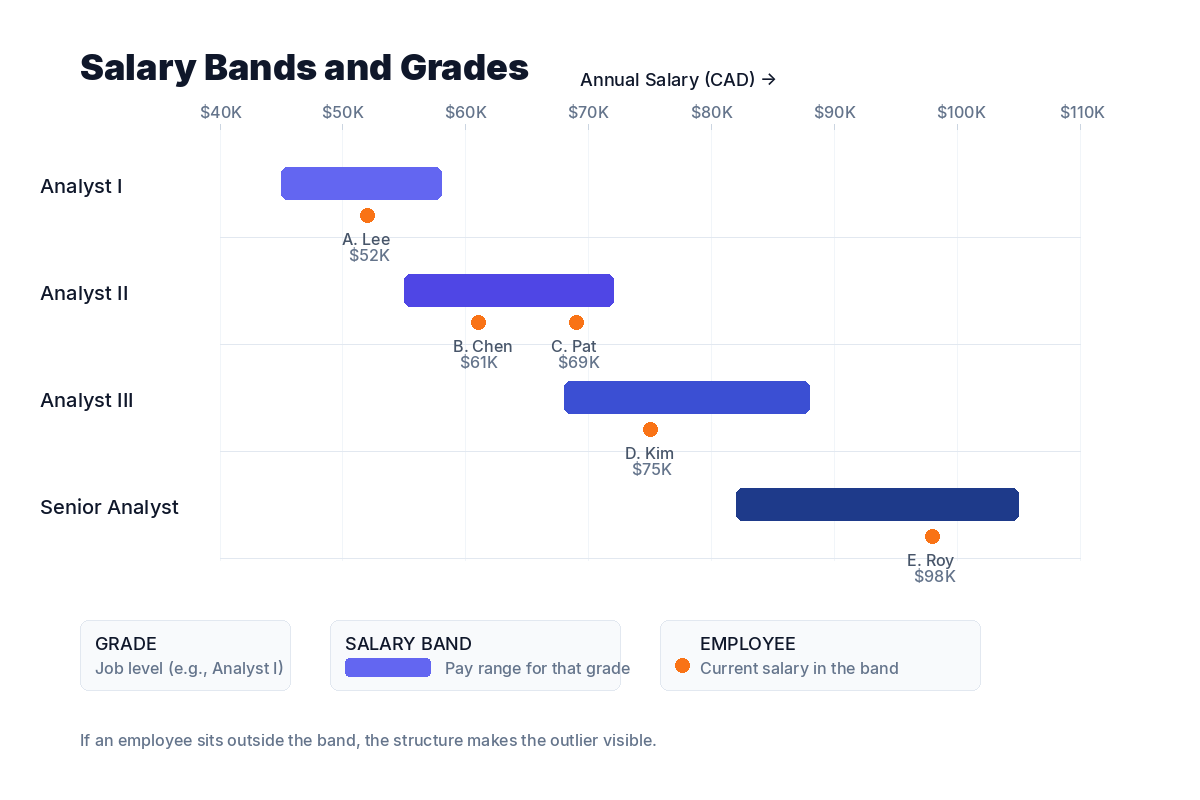
The band also does three practical things:
- It sets expectations before the conversation starts. An employee can see where they sit and what the ceiling is for their current level. That removes the guessing game.
- It makes promotion and progression visible. Moving to a higher band is a clearer signal than a percentage raise inside the same band. It connects pay to job level, not just performance review timing.
- It surfaces inconsistent pay decisions. When every role has a band, it becomes obvious if one department pays more than another for similar work, or if one manager negotiates outside the structure.
Why this matters to employees
Most employees do not leave because they are underpaid. They leave because they do not understand how pay works. They get an offer, accept it, and then spend years wondering whether they are being treated fairly. A public salary range does not solve that by itself, but it does start the conversation.
Employees want a roadmap. They want to know what the next level looks like, what it pays, and what it takes to get there. A well-maintained band structure gives them that. It turns compensation from a mystery into a career-planning input.
This is especially important in smaller organizations where promotion paths are informal. Without bands, advancement depends on who asks, who their manager is, and whether the timing is right. With bands, the path is visible even if the organization is flat.
Why this matters to management
Salary bands force management to make decisions that are usually hidden. What is the highest-paid version of this role? What is the lowest? How wide should the band be? Should there be overlap between levels? These questions are uncomfortable because they expose inconsistency.
Once bands exist, every pay decision can be compared to the band. A manager who wants to hire above the band has to explain why. A manager who wants to keep someone at the bottom has to explain why. The band does not remove discretion, but it makes discretion visible.
This visibility also helps with budget planning. Finance can model headcount against bands instead of guessing. HR can forecast raises and promotions as a percentage of payroll. The conversation shifts from "Can we afford this person?" to "What level do we need?"
Bands also make benchmarking actionable. Once you know the market rate for a grade, you can compare every employee in that grade against the band and the benchmark. People above the band maximum become visible. People below the band minimum become visible. Without bands, those outliers hide inside broad job titles and manager discretion.
Where most organizations get stuck
Building bands is not technically hard. The hard part is agreeing on them. Every department thinks its roles are special. Every manager has a story about why their top performer deserves an exception. Every executive has a historical hire that does not fit the new structure.
The result is often a spreadsheet that looks good in a meeting but is not connected to the HRIS. Job postings get ranges copied from the spreadsheet. Internal pay decisions still happen outside it. Over time the spreadsheet drifts and the organization is back to guessing.
When the exception list gets too long, it is usually a sign that the grades are wrong. A single role with too many exceptions is often two or three roles hiding under one name. If every senior analyst needs a different salary story, the company may need Analyst II, Analyst III, and Senior Analyst as separate grades. The band should fit the work, not force the work to fit the band.
The fix is to put the bands into the system of record. The job code, the level, and the band minimum and maximum should live in the HRIS and flow into the ATS, the compensation planning tool, and the payroll system. If the band is only in a document, it is a suggestion. If it is in the system, it is a rule.
Bands also need maintenance. A salary band built in 2022 is not reliable in 2026 unless it has been adjusted for market movement and any general salary increases. The band should be reviewed on a regular schedule, just like job descriptions and performance criteria. If the company applies a cost-of-living or general wage adjustment, the band minimum and maximum should move with it. Otherwise the band drifts away from reality and employees who are at the top of an outdated band suddenly have no room.
The bottom line
Pay transparency laws are forcing employers to publish ranges, but the best reason to build salary bands is not the law. It is that employees deserve a roadmap and managers deserve a structure. Compliance is the reason to start. Clarity is the reason to finish.
AI disclosure: This post was drafted with AI assistance and reviewed by Kyle Yuen.