How often have you watched a manager make a call because they "had a feeling"? Or because "that's what worked ten years ago"? Or because a vendor sounded convincing in a meeting?
These are three different versions of the same problem: a decision made without asking what the current situation actually requires.
Three ways decisions get made
Level 1: Gut decisions. "I feel good about this." Gut decisions are fast, but in day-to-day operations they are usually unconscious bias dressed up as confidence.
Level 2: Experience decisions. "This worked before." Experience is valuable. Experts recognize patterns that juniors miss. But the trap is assuming the past guarantees the future. The context changes. Markets change. Teams change. Tools change. What worked once may not work now.
Level 3: Evidence-based decisions. "What does the current data say?" Modern operations leaders combine data with structured judgment. They ask: What are we deciding? What do we know? What is missing? What would have to be true for this to be the right call? How will we know if we are wrong?
This does not remove human judgment. It makes judgment more precise.
The real shift
Operations used to move slowly. Managers could rely on memory because the business changed once a year. Now systems, tools, and expectations shift constantly. The half-life of operational experience is shorter than ever.
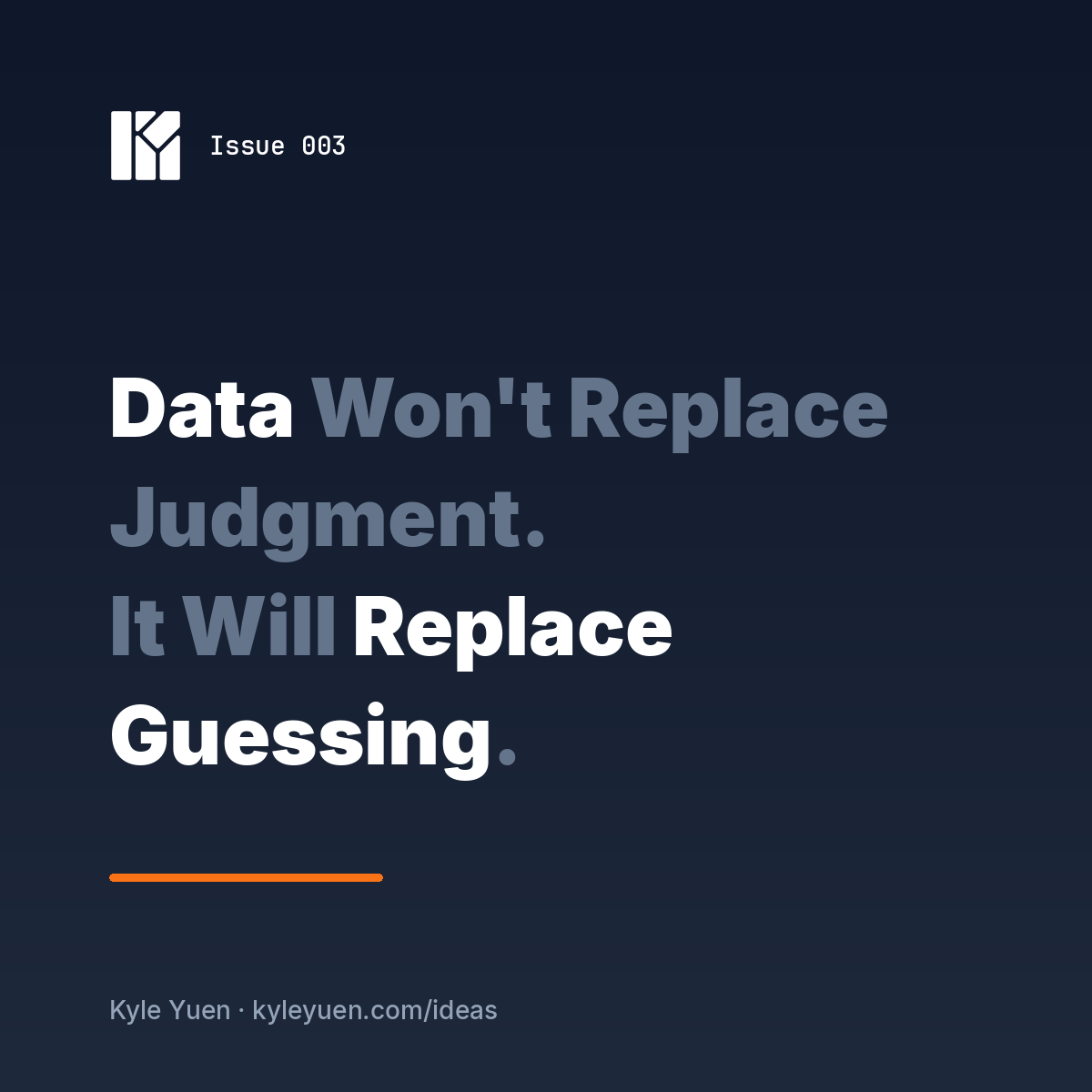
Data does not replace judgment. It replaces guessing.
A simple test
The next time a decision comes up, ask: "If we had no data at all, what would make us believe this is the right call?"
If the only answer is "trust me" or "we have always done it this way," you are not making a decision. You are guessing.
A practical test
The next time a decision comes up, ask: "If we had no data at all, what would make us believe this is the right call?"
If the only answer is "trust me" or "we have always done it this way," you are not making a decision. You are guessing.
The point is not to collect more dashboards. It is to build a habit where assumptions get named, evidence gets weighed, and conclusions can be updated when the facts change.
Frameworks worth knowing
System 1 / System 2 thinking
Daniel Kahneman — Fast, intuitive decisions versus slow, analytical ones.
Evidence-based management
Jeffrey Pfeffer and Robert Sutton — Applying evidence-based practice from medicine to management.
Cynefin framework
Dave Snowden — Matches the decision method to the situation: clear, complicated, complex, or chaotic.
Share this idea
If it resonated, pass it on.